

Cart
0
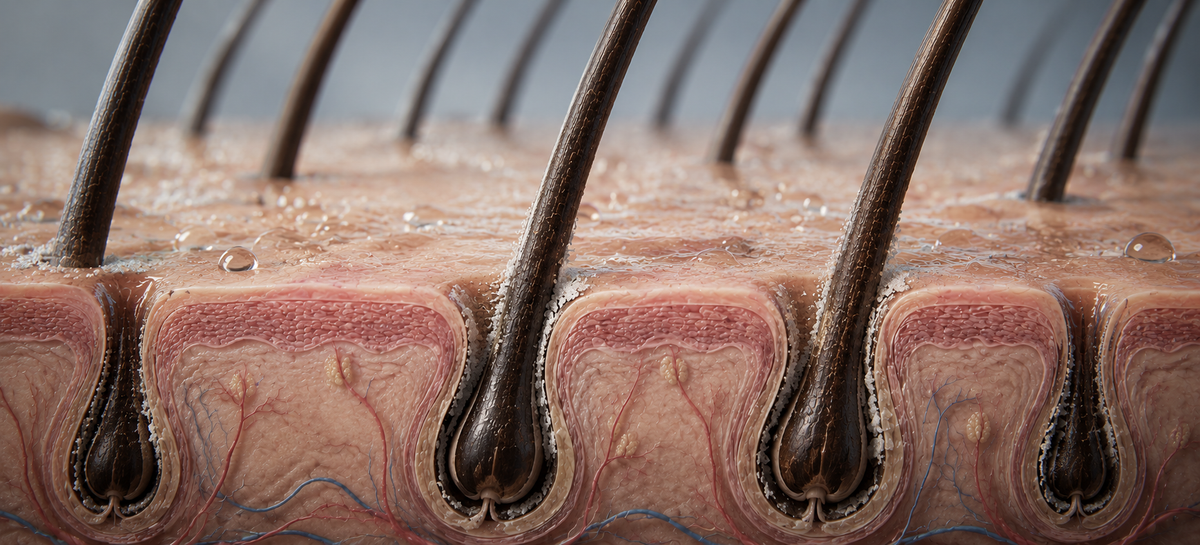
Table of Content
- Hard Water and Your Hair: Why No Product Can Completely Solve the Problem
- Quick Answer
- Why This Matters
- What You’ll Learn in This Guide
- Understanding the Science
- How Hard Water Affects Hair: 5 Mechanisms
- The Missing Piece: Mineral Deposition vs. Mineral Clearance
- What Actually Helps: A Practical Strategy
- What Doesn’t Help
- A Practical Checklist
- Frequently Asked Questions
- Scientific References
Hard Water and Your Hair: Why No Product Can Completely Solve the Problem
Understanding Hard Water Hair Damage — and why it keeps coming back
Dr. Vinod Dhanuka, Ph.D. — 45+ years in R&D and formulation science
Quick Answer
Hard water does not damage hair because it is dirty. It damages hair because it contains dissolved minerals — primarily calcium and magnesium — that remain on the hair after every wash. As the water evaporates, these minerals form microscopic deposits on the hair surface, gradually increasing roughness, reducing shine, making conditioning less effective, and contributing to dryness and breakage. This cumulative pattern is what formulation scientists mean by Hard Water Hair Damage — and it differs from ordinary dirt or product buildup. Shampoos, conditioners, and water filters can reduce these effects, but no product can completely prevent new mineral deposits from forming every time hard water dries on hair.
Why This Matters
If you have ever wondered why your hair suddenly feels rough, looks dull, tangles more easily, or seems impossible to manage despite using a good shampoo or conditioner, the answer may not be sitting on your bathroom shelf. It could be flowing from your shower.
Millions of people living in hard-water areas unknowingly expose their hair to dissolved minerals every time they wash it. Unlike dust or dirt, these minerals cannot simply be rinsed away. They accumulate gradually over hundreds of wash-and-dry cycles, making hair feel increasingly dry and less responsive to even the best hair care products.
Understanding this changes the question from “Which product will fix my hair?” to a far more useful one: “What is happening to my hair, and what can I realistically do about it?” That shift in thinking is the first step toward better hair care decisions.
What You’ll Learn in This Guide
-
Why hard water affects hair differently from soft water
-
The science behind mineral buildup on the hair surface
-
Why even expensive shampoos cannot completely overcome hard water
-
The one scientific concept that explains why the problem keeps returning
-
Practical ways to reduce long-term hard water damage
-
Common myths and misconceptions about hard water and hair
Understanding the Science

Before discussing shampoos, conditioners, or treatments, it helps to understand one simple fact: hair is remarkably durable, but it cannot repair itself.
Unlike skin, which continuously renews itself, each hair fibre is biologically inactive once it emerges from the scalp. Every wash, every brush stroke, and every environmental exposure gradually changes the condition of the hair until it is eventually cut away. That is why protecting the hair surface matters so much.
What Makes Healthy Hair Feel Smooth?
Imagine a tiled roof viewed from a distance. When every tile lies flat, rain runs off easily and the roof appears smooth. Human hair is built in much the same way.
Its outer protective layer, the cuticle, consists of overlapping microscopic scales that shield the inner structure of the hair. Covering these scales is an extremely thin natural lipid layer, rich in 18-methyleicosanoic acid (18-MEA), which helps hair feel smooth, repel excess water, and reduce friction between individual fibres. This covalently bound lipid layer is now well documented in hair science as the primary source of hair’s natural hydrophobicity and shine.[¹] When this protective surface stays intact, hair reflects light well, feels soft, and tangles less easily. When it becomes damaged, hair behaves very differently.
Where Hard Water Fits Into the Picture
Hard water contains dissolved calcium and magnesium ions. These minerals are perfectly safe to drink, but they do not simply disappear after washing your hair. As water evaporates, the dissolved minerals remain behind and begin to accumulate on the hair surface.
Initially, the deposits are microscopic and impossible to see. Over hundreds of wash-and-dry cycles, however, they gradually alter how hair looks, feels, and responds to conditioning. This is why hard water is best understood as a cumulative exposure, not a one-time event.
The Formulation Scientist’s Observation
One of the biggest misconceptions about hard water is expecting to notice its effects after a few washes. In reality, hard water behaves much like sunlight: a single day in the sun rarely causes long-term skin ageing, but years of repeated exposure do. Hard water affects hair the same way — the changes are gradual, often unnoticed at first, but they accumulate over time until hair feels noticeably rougher, duller, and less manageable.
How Hard Water Affects Hair: 5 Mechanisms
Hard water does not damage hair through a single process. It influences the hair surface in several interconnected ways — some effects immediate, others developing gradually over months or years of repeated exposure. Understanding these mechanisms helps explain why no single shampoo or conditioner can completely overcome the effects of hard water.

Mechanism 1: Mineral Deposits Roughen the Hair Surface
Every time hard water dries on your hair, microscopic amounts of calcium and magnesium remain behind. Individually insignificant, they gradually accumulate over hundreds of wash-and-dry cycles — the earliest stage of mineral build up on hair. As these deposits build up, the normally smooth cuticle becomes rougher, and hair fibres no longer glide smoothly — increasing friction during washing, brushing, and styling. This is often the earliest reason hair begins to feel coarse, lose its natural shine, and become harder to comb.
Scientific insight: Hair doesn’t become rough overnight. It becomes rough one microscopic mineral deposit at a time.
Mechanism 2: Hard Water Reduces Shampoo Performance
Most shampoos are formulated to work optimally in soft or moderately hard water. Calcium and magnesium ions interact directly with the anionic surfactants used in most cleansers, forming insoluble complexes that reduce the concentration of active surfactant available for cleansing — a mechanism confirmed in recent formulation research showing significantly reduced foam stability and cleansing performance in hard water compared to soft water.[²] As a result, many people compensate by washing more frequently or using stronger shampoos, often without realising the water itself is contributing to the problem. The shampoo may not have changed. The water has.
Mechanism 3: Conditioners Become Less Effective
Conditioners work by depositing conditioning ingredients evenly over the hair surface. When mineral deposits already coat the hair, this conditioning layer becomes less uniform and less effective. Hair may still feel conditioned immediately after washing but lose softness much more quickly as mineral accumulation continues. This is one reason consumers often believe they need a “stronger conditioner,” when the underlying problem may actually be repeated mineral deposition.
Mechanism 4: Increased Friction Leads to More Breakage
Healthy hair fibres slide smoothly against one another. Mineral deposits increase surface roughness, causing neighbouring hairs to catch, tangle, and resist movement. The extra force required during brushing, towel-drying, and styling places greater mechanical stress on the hair shaft. Over time, this repeated friction contributes to increased fibre breakage, split ends, and a gradual loss of smoothness and manageability. Importantly, this is hair breakage, not true hair loss from the scalp.
Mechanism 5: Hard Water Gradually Weakens the Hair’s Natural Defences
Hair is naturally protected by its cuticle and the thin 18-MEA lipid layer that reduces friction and repels excess water. Repeated exposure to hard water, combined with everyday weathering from washing, UV exposure, heat styling, and grooming, gradually compromises this protective surface. As the surface becomes more damaged, it also becomes more attractive to further mineral deposition. In other words, damaged hair tends to accumulate minerals more readily than healthy hair — creating a cycle that becomes progressively harder to reverse.
What These Five Mechanisms Have in Common
Although each mechanism affects hair differently, they all point to the same conclusion: hard water is not a one-time event. It is a repeated environmental exposure that slowly changes the hair surface.
That raises an important question: if mineral deposits are left behind after every wash, why do they continue building up even when we use better shampoos, conditioners, or shower filters? The answer lies in a simple scientific principle that surprisingly few discussions of hard water ever explain.
The Missing Piece: Mineral Deposition vs. Mineral Clearance
The five mechanisms above explain how hard water changes the hair surface. They do not fully explain why the effects continue even after switching shampoos, using conditioners, or installing a shower filter.
To understand that, think about hard water not as a shampoo problem, and not as a conditioner problem — but as a balance.
Every Hair Wash Creates Two Opposing Processes
Every time you wash your hair, two things happen simultaneously: some minerals already present on the hair are removed during washing, while fresh calcium and magnesium from the hard water are deposited on the hair as it dries. Hair health depends on a simple balance:
Mineral Deposition vs. Mineral Clearance
If more minerals are removed than deposited, hair gradually becomes cleaner and easier to manage. If more minerals are deposited than removed, build-up slowly increases with every wash. This balance explains why hair condition changes gradually rather than suddenly.
The Evaporation Step Most People Never Consider
When you finish washing your hair, the water disappears — the minerals do not. As the thin film of water left on the hair evaporates, calcium and magnesium remain behind as microscopic deposits. The amount left after a single wash is extremely small, but hair is rarely washed only once. Over months and years, hundreds and thousands of wash-and-dry cycles gradually increase the total mineral burden on the hair surface — direct evidence of magnesium accumulation on hair shafts exposed to hard water has been documented using scanning electron microscopy and elemental analysis.[³] This is why hard water is best understood as a cumulative exposure, rather than a one-time event.
A Simple Analogy
Most people have noticed the white scale that gradually forms inside a kettle used with hard water. The kettle is not becoming dirty — it is collecting minerals left behind after repeated heating and evaporation. Hair undergoes the same basic process. The difference is that the deposits are microscopic rather than visible. Every wash leaves behind only a tiny amount; over time, those tiny amounts accumulate.
Why There Is No Permanent Solution
This also explains why no shampoo, conditioner, or treatment can permanently solve hard water damage. Even the best products can only influence one side of the equation — some help remove existing mineral deposits, others improve the feel of hair despite those deposits, but none can stop new minerals arriving every time hard water touches your hair. Realistic hair care is about managing the balance, not expecting a permanent cure.
The Formulation Scientist’s Perspective
I believe the most useful way to understand hard water is not to ask whether minerals ever reach the hair — they almost always do. The more important question is whether they accumulate faster than they are naturally or periodically removed. Once you begin thinking in terms of mineral deposition versus mineral clearance, many everyday hair care experiences suddenly make sense.
Why This Matters in Practice
This single concept explains several everyday experiences: why the same shampoo performs differently in different cities; why hair often feels better in soft water; why expensive conditioners cannot completely overcome hard water; and why improvements from chelating shampoos are temporary. It also explains why reducing mineral exposure is often just as important as choosing the right product.
Instead of searching for a miracle solution, the goal becomes far more realistic: keep mineral accumulation below the point where it begins to affect the look and feel of your hair.
What Actually Helps: A Practical Strategy
Once you understand that hard water is a problem of ongoing mineral deposition, the objective becomes much clearer. Rather than searching for a single “miracle” product, the goal is to reduce mineral build-up while protecting the natural surface of the hair. No single intervention solves every aspect of hard water — several small improvements together produce the best long-term results.
1. Reduce Mineral Exposure Whenever Possible
The most effective solution is to reduce the amount of calcium and magnesium reaching your hair. A home water softener can significantly reduce water hardness before it reaches the shower. Where this isn’t practical, a shower filter for hard water may still improve overall water quality by reducing chlorine, sediment, and certain impurities — but many standard shower filters remove only limited amounts of calcium and magnesium, so expectations should remain realistic.
2. Chelating Shampoo: Remove Mineral Build-Up Periodically
Chelating shampoos contain ingredients that bind calcium and magnesium already deposited on the hair, allowing them to be washed away more effectively. Used occasionally, they can help restore the feel of hair. Used too frequently, they may increase dryness, since they’re designed to cleanse more deeply. For most people, periodic use is more appropriate than daily use.
3. Protect the Hair Surface
A well-formulated conditioner helps reduce friction between hair fibres and improves combability. Whether it contains silicones or alternative conditioning ingredients depends on individual preference and hair type — the important point is that conditioners improve the feel of hair, but they do not prevent new mineral deposits from forming. Managing expectations is just as important as choosing the right formulation.
4. Avoid Unnecessary Washing
Every wash is another opportunity for minerals to be deposited on the hair. This does not mean washing less is always better — scalp health, climate, exercise, and lifestyle all influence how often hair should be washed. But washing more frequently than your scalp requires simply increases the number of deposition cycles without additional benefit.
5. Consider a Final Low-Mineral Water Rinse
In areas with very hard water, a final rinse using low-mineral water — such as reverse osmosis (RO) water — can reduce the amount of calcium and magnesium left on the hair immediately before drying. This may not be practical for everyone, but it directly addresses the final stage of the mineral deposition cycle.
What Doesn’t Help
Just as important as knowing what helps is understanding what cannot realistically solve the problem.
✗ Simply changing shampoos. A better shampoo may improve cleansing, but it cannot change the mineral content of your water.
✗ Expecting one product to permanently solve hard water. No shampoo, conditioner, or treatment can completely prevent new mineral deposits forming after every wash.
✗ Assuming expensive products always work better. Price does not determine how well a product performs in hard water. Understanding the cause of the problem is often more valuable than buying a more expensive formulation.
A Simple Way to Think About It
Instead of asking “Which product is best for hard water?”, try asking “Does this help reduce mineral build-up, protect the hair surface, or both?” That simple shift leads to much more realistic expectations and better long-term hair care decisions.
A Practical Checklist
|
Goal |
What Helps |
What to Expect |
|---|---|---|
|
Reduce mineral exposure |
A water softener, or to a lesser extent, a shower filter for hard water |
Less mineral contact with hair |
|
Remove mineral build up on hair |
Periodic use of a chelating shampoo |
Temporary reduction in build-up |
|
Protect the hair surface |
A suitable conditioner |
Improved smoothness and easier combing |
|
Reduce repeated exposure |
Wash only as often as your scalp needs |
Fewer mineral deposition cycles |
|
Minimise final deposition |
Final rinse with low-mineral water |
Less residue left after drying |
The Formulation Scientist’s Perspective
One of the most common mistakes in hair care is expecting a single product to solve what is fundamentally an environmental problem. Hard water is not a defect in your shampoo — it is part of the environment your hair experiences every time you wash it. The most successful approach rarely comes from one product. It comes from understanding the underlying cause and making small, practical changes that gradually shift the balance in your favour.
Frequently Asked Questions
Does hard water damage hair?
Hard water does not permanently change the biology of newly growing hair. However, repeated mineral deposition gradually alters the surface of existing hair fibres, making them feel rougher, look duller, and become more prone to breakage. Since hair cannot repair itself once it grows out of the scalp, protecting the hair surface is important.
Can hard water cause hair loss?
Current scientific evidence does not show that hard water directly causes permanent hair loss. It can increase hair fibre breakage and make hair appear thinner or less voluminous, but hair breakage should not be confused with hair loss from the scalp.
Why does my conditioner seem less effective in hard water?
Mineral deposits can interfere with the even distribution of conditioning ingredients on the hair surface. As a result, hair may feel softer immediately after conditioning but lose that smoothness more quickly as mineral build-up continues.
Do shower filter help?
It depends on the filter. Many shower filters improve water quality by reducing chlorine, sediment, and certain impurities. Most, however, remove only limited amounts of calcium and magnesium, which are responsible for water hardness — so a shower filter for hard water may help, but shouldn’t be viewed as a complete solution on its own.
Are chelating shampoos safe to use?
Yes, when used appropriately. Chelating shampoos are designed to remove mineral deposits from the hair. Used occasionally, they can improve the feel and manageability of hair. Daily use, however, may increase dryness because they provide a deeper level of cleansing.
Does rinsing with RO water really make a difference?
In areas with very hard water, a final rinse using reverse osmosis (RO) water can reduce the amount of dissolved minerals left on the hair before drying. While not practical for everyone, it directly reduces the final mineral deposition step.
Is hard water worse for coloured or chemically treated hair?
Generally, yes. Chemically treated hair often has a more porous and damaged cuticle, making it easier for minerals to accumulate. This can contribute to increased dryness, roughness, and colour fading over time.
If I move to a soft-water area, will my hair immediately improve?
Not immediately. Although new mineral deposition decreases, existing deposits and previous hair damage remain until they are gradually removed or the affected hair grows out and is trimmed.
Scientific References
-
Robbins, C.R. et al. — Research on 18-methyleicosanoic acid (18-MEA) confirms it as the primary covalently bound lipid on the hair cuticle surface, responsible for hair’s natural hydrophobicity, smoothness, and shine. ScienceDirect · PubMed
-
Formulation research (2026) measured foam stability and cleansing performance decline in hard water versus soft water, attributing the effect to calcium and magnesium ions binding with anionic surfactant molecules and reducing active surfactant availability. Cosmetics Design Europe
-
Srinivasan, G. et al. (2016). Scanning electron microscopy of hair treated in hard water. International Journal of Dermatology. Found significantly greater magnesium deposition on hair shafts treated with hard water compared to distilled water. PubMed · Wiley
-
A related SEM study on hair shaft changes related to water hardness similarly found a statistically significant increase in magnesium deposition (P = 0.001) in the hard-water-exposed group, though without corresponding significant surface structural change under SEM at 3 weeks. Indian Journal of Dermatology, Venereology and Leprology. IJDVL
Dr. Vinod Dhanuka is the founder of iCosmétiques, with 45+ years of R&D and formulation experience including 25 years at Hindustan Unilever and 20 years at Reliance Retail. The Scientific Consumer Guide Series is published to help consumers make informed, evidence-based beauty decisions — devoid of marketing claims.

