

Cart
0
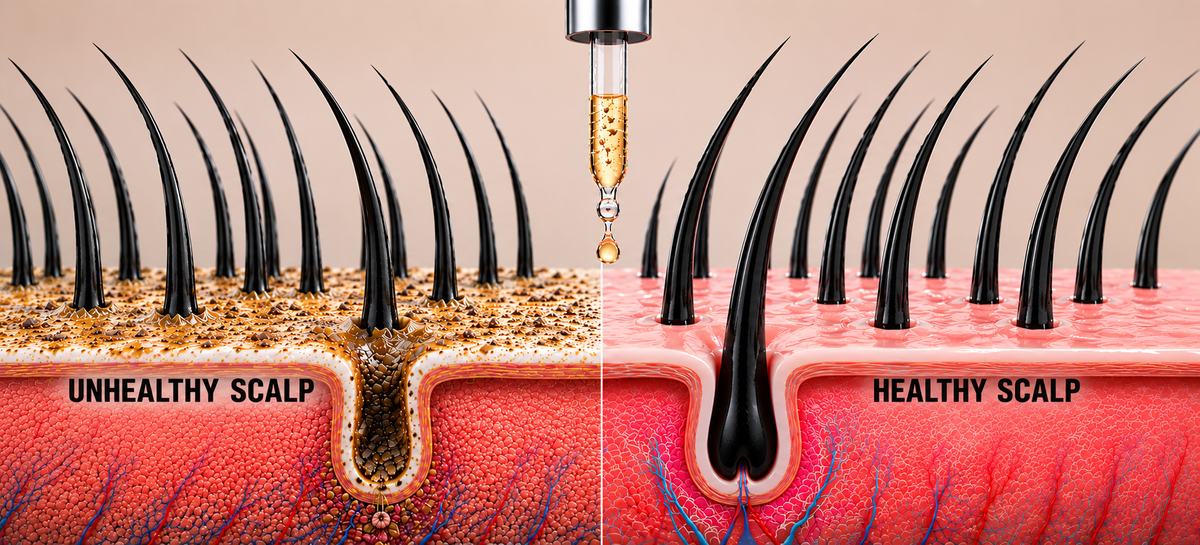
Table of Content
- Hair Growth Serums: Why Scalp Preparation Comes Before the Serum, Not After
- Quick Answer
- Why This Matters
- What You’ll Learn in This Guide
- Understanding the Science
- Two Barriers That Stand Between a Serum and the Follicle
- The Missing Piece: Follicle Viability vs. Follicle Dormancy
- What Actually Helps: A Practical Strategy
- What Doesn’t Help
- A Practical Checklist
- Frequently Asked Questions
- Scientific References
Hair Growth Serums: Why Scalp Preparation Comes Before the Serum, Not After
Understanding why the same serum works for one person and not another
Dr. Vinod Dhanuka, Ph.D. — 45+ years in R&D and formulation science
Quick Answer
A hair growth serum can only work if the follicles beneath it are still biologically capable of responding. If the scalp is coated in silicone buildup or its natural barrier has been stripped by harsh sulphates, even a well-formulated serum struggles to reach the follicle. This is why scalp preparation — not the serum itself — is usually the deciding factor in whether a hair growth routine succeeds or quietly fails.
Why This Matters
Hair growth serums are one of the most heavily marketed categories in beauty, and also one of the most inconsistently effective. Two people can use the identical product and see completely different results — not because one product formula “worked” and the other “didn’t,” but because the scalp receiving it was in a different starting condition.
This is rarely explained on the product label. Most marketing focuses entirely on the serum’s active ingredients, leaving the consumer to assume that the bottle alone determines the outcome. In reality, the scalp environment the serum is applied to matters just as much as what’s inside the bottle.
Understanding this shifts the question from “Which serum should I buy?” to a more useful one: “Is my scalp in a condition where a serum can actually do its job?” That distinction can be the difference between a routine that works and one that quietly wastes months.
What You’ll Learn in This Guide
-
Why the same hair growth serum performs differently on different people
-
How silicone and sulphate residue interferes with serum absorption
-
The biological difference between a dormant follicle and a permanently inactive one
-
Why a two-week preparation phase is often more important than the serum itself
-
What a realistic hair growth timeline actually looks like
-
Common myths about hair growth serums and instant results
Understanding the Science

Before evaluating any hair growth serum, it helps to understand a basic biological fact: a serum cannot work on a follicle it cannot reach.
Hair follicles sit beneath the scalp surface, drawing nourishment from blood supply and responding to signals in their immediate environment. Anything that physically blocks or chemically disrupts that immediate environment — including residue left behind by everyday hair products — limits how much of a serum’s active ingredients ever reach their intended target.
What a Healthy Scalp Environment Looks Like
A well-functioning scalp has a balanced lipid barrier, open and unobstructed follicles, and a stable microbial environment. This is the baseline condition formulation science assumes when a serum is tested and marketed. It is not, however, the baseline condition most consumers’ scalps are actually in — because most everyday shampoos and conditioners leave some degree of residue behind.
Where Buildup Comes From
Two ingredient categories are most responsible for this residue: silicones, which are added to shampoos and conditioners for immediate shine and smoothness, and sulphates, the harsh surfactants used to create a strong lather. Neither is inherently dangerous — but used repeatedly over months and years, both can leave the scalp in a condition that works against, rather than for, a hair growth routine.
The Formulation Scientist’s Observation
I think of scalp preparation the same way a dermatologist thinks about skin before starting a new treatment: the product is only ever half the equation. A brilliant formulation applied to an unprepared surface will underperform every time — not because the formulation failed, but because the surface was never ready to receive it.
Two Barriers That Stand Between a Serum and the Follicle
Barrier 1: Silicone Buildup
Silicones such as dimethicone are added to conditioners and styling products to create an immediate, durable, smooth coating on the hair and scalp.[¹] That coating is intentional and, in moderation, maybe useful in short term — but because silicones are largely water-insoluble, repeated use without adequate clarifying can allow a film to persist on the scalp surface across many wash cycles.[²] Formulation research on hair conditioning systems shows that cationic surfactants and diesterquats are specifically engineered to increase how much silicone deposits and remains on the fibre and scalp with each use[³] — which is precisely why the same coating that gives an immediate smoothing effect can, over time, sit between a growth serum and the follicle it is meant to reach.
Barrier 2: Sulphate-Stripped Scalp Barrier
At the other extreme, harsh sulphate surfactants like sodium lauryl sulphate (SLS) are well documented in dermatological research as skin irritants — used deliberately in clinical studies as control surfactant to induce measurable barrier disruption, because they strip surface lipids (ceramides) and increase transepidermal water loss.[⁴] A scalp that is repeatedly stripped this way is inflamed and imbalanced rather than clogged — a different problem from silicone buildup, but one that is equally unfavourable for a follicle trying to respond to a growth-supporting serum.
Why Both Problems Point to the Same Solution
Whether the scalp is coated in silicone residue or irritated by harsh sulphates, the underlying issue is the same: the scalp environment is not in the condition a hair growth serum was designed to work in. This is why the most effective first step in any hair growth routine is not choosing a serum — it is preparing the scalp to receive one.
The Missing Piece: Follicle Viability vs. Follicle Dormancy
Even a perfectly prepared scalp cannot guarantee results, because not every follicle is in the same biological state. Understanding the difference between a dormant follicle and a degenerated one is essential to setting realistic expectations.
Two Very Different Starting Points
A dormant follicle is one that has temporarily paused hair production but retains the underlying structures needed to resume it. A degenerated follicle has lost those structures after prolonged, untreated miniaturization. Clinical biopsy research on androgenetic alopecia has demonstrated that follicle miniaturization can be partially reversed with consistent treatment when caught early — but the same research shows this reversal is measurably harder to achieve as miniaturization becomes more advanced.[⁵]
The Formulation Scientist’s Perspective
No cosmetic serum, however well formulated, can revive a follicle that has undergone this degeneration process. This is not a marketing disclaimer — it is a biological limit. The honest purpose of a well-formulated serum is to support follicles that are dormant or still viable, not to promise reversal of follicles that no longer are.
Why This Matters in Practice
This explains several common experiences: why a serum that worked for a friend may not work as well for you; why results typically take 8–12 weeks rather than days; why continued use matters more than product-switching; and why earlier intervention consistently produces better outcomes than waiting until thinning is advanced.
What Actually Helps: A Practical Strategy
1. Run a Two-Week Scalp Reset Before Starting a Serum
Switch to a sulphate-free and silicone-free shampoo and conditioner for a minimum of two weeks before introducing a growth serum. This gives existing buildup time to clear and gives the scalp barrier time to recalibrate.
2. Cleanse Without Stripping
Choose a gentle, pH-balanced, sulphate-free shampoo that removes residue without triggering the same irritation response associated with harsh surfactants.
3. Apply Serum to a Clean, Dry or Slightly Damp Scalp
Serums penetrate more effectively when applied directly to a freshly cleansed scalp rather than layered over existing product residue from the day.
4. Maintain Consistency for at Least 8–12 Weeks
Hair growth cycles operate on a timescale of months, not days. Switching products before a full cycle has elapsed makes it difficult to judge whether a serum is actually working.
5. Avoid Reintroducing Heavy Silicones Mid-Routine
Returning to heavy silicone-based styling products during a growth routine can undo the scalp clarity a preparation phase achieved.
What Doesn’t Help
✗ Expecting visible results within days. Hair growth is a biological cycle measured in weeks and months, not a cosmetic effect measured in hours.
✗ Applying serum over unwashed, product-laden hair. This significantly limits how much of the serum reaches the scalp at all.
✗ Assuming any dormant follicle can be revived. Some degree of follicle loss is beyond what any topical product can reverse.
A Simple Way to Think About It
Instead of asking “Which growth serum is strongest?”, ask “Is my scalp actually prepared to let a serum reach the follicle?” The second question determines the outcome far more often than the first.
A Practical Checklist

The Formulation Scientist’s Perspective
The most common mistake I see in hair growth routines is treating the serum as the entire solution. It is one part of a two-part system — the other part is the scalp environment it is applied to. Get the preparation right, and a good serum has a genuine chance to work. Skip it, and even an excellent formulation is fighting an uphill battle it was never designed for.
Frequently Asked Questions
Do hair growth serums actually work?
They can, but only under the right conditions — a scalp free of heavy buildup, follicles that are dormant rather than fully degenerated, and consistent use over a full growth cycle of 8–12 weeks or more.
Why did a hair growth serum work for someone else but not for me?
Results depend heavily on the individual scalp environment and follicle condition at the time of use, not just the serum formula itself.
Can a dormant hair follicle be revived?
Sometimes, under supportive conditions and consistent treatment. Clinical research shows early-stage miniaturization responds better to treatment than advanced miniaturization.[⁵]
Is silicone buildup really a problem for hair growth serums?
It can be, since silicones are formulated specifically to create a durable, water-resistant film on the hair and scalp, which may limit how well other actives penetrate with repeated use.
How long should I prepare my scalp before starting a growth serum?
A minimum of two weeks with a sulphate-free, silicone-free routine is a reasonable starting point.
Is it normal not to see results for weeks?
Yes. Hair growth cycles operate over months, so meaningful change is rarely visible before 8–12 weeks of consistent use.
Can a sulphate shampoo undo the benefits of a growth serum?
Repeated use of harsh sulphates can irritate and strip the scalp barrier, creating a less favourable environment for a serum to work in.
Scientific References
-
Dimethicone deposition mechanisms and their effect on hair fibre friction and shine are well characterised in cosmetic chemistry literature on silicone conditioning systems. Hairswiss Technical Review
-
Streaming potential studies on keratin fibres confirm that silicone copolymer deposition is influenced by surfactant and polymer interactions, explaining how residue accumulates on hair and scalp surfaces over repeated use. ScienceDirect
-
Formulation patents on hair conditioning systems confirm that cationic surfactants and diesterquats are specifically used to increase silicone deposition and retention on the fibre with each application. USPTO Patent Filing
-
Löffler, H. & Effendy, I. Sodium lauryl sulfate (SLS)-induced irritant contact dermatitis: a correlation study between ceramides and in vivo parameters of irritation. Confirms SLS reliably strips stratum corneum lipids and increases transepidermal water loss. PubMed
-
Whiting, D.A. et al. Measuring reversal of hair miniaturization in androgenetic alopecia by follicular counts in horizontal sections of serial scalp biopsies. Found measurable reversal of miniaturization with early, consistent treatment, and reduced reversal potential in more advanced cases. PubMed
Dr. Vinod Dhanuka is the founder of iCosmétiques, with 45+ years of R&D and formulation experience including 25 years at Hindustan Unilever and 20 years at Reliance Retail. The Scientific Consumer Guide Series is published to help consumers make informed, evidence-based beauty decisions — devoid of marketing claims.

