

Cart
0
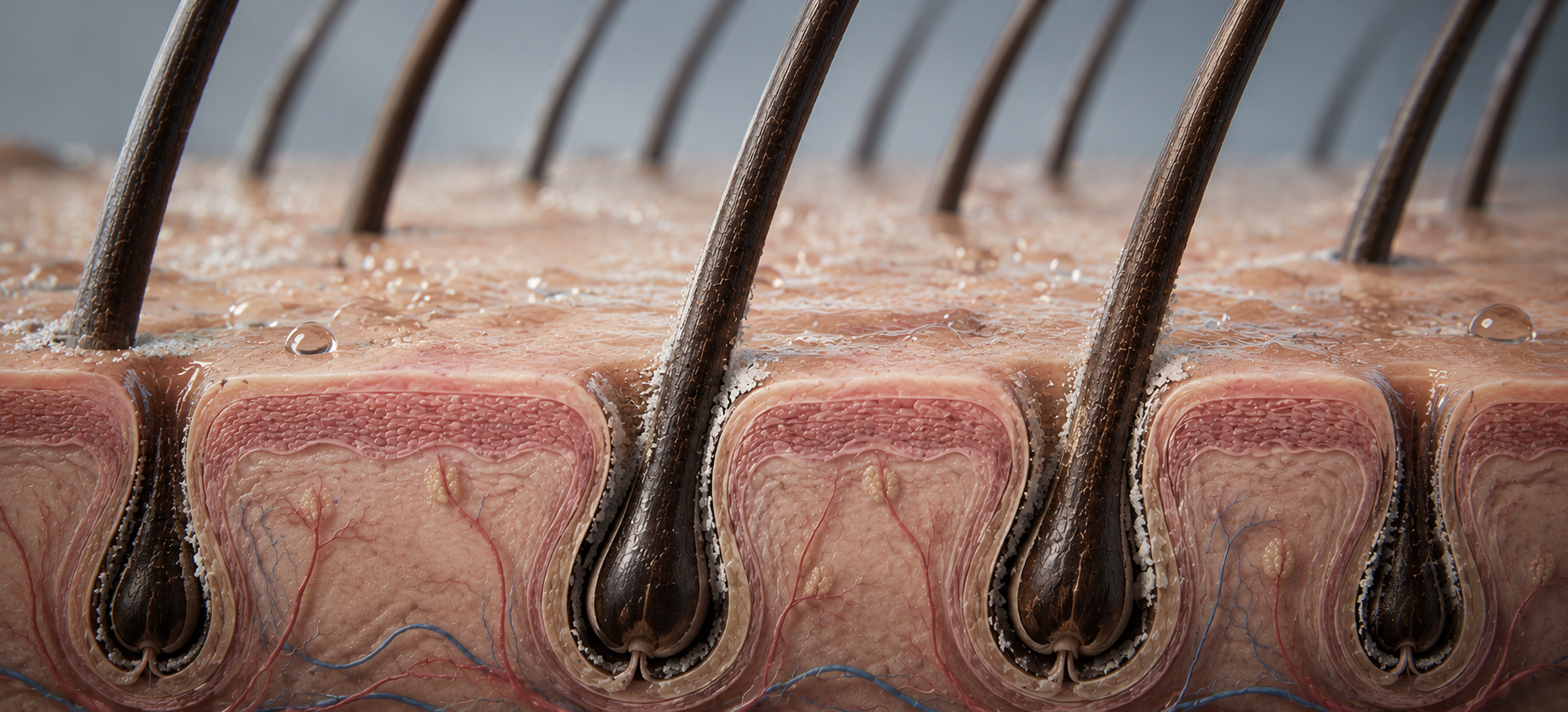
Most discussions about hard water and hair focus on the same five mechanisms of damage. They are real, well documented, and widely studied. But there is a sixth mechanism almost nobody talks about— and it explains why no shampoo, filter, or conditioner can completely solve the problem.
What hard water does to hair
Hard water contains elevated levels of dissolved calcium (Ca²⁺) and magnesium (Mg²⁺). Research has consistently shown five major ways these minerals affect hair and scalp health:
-
Mineral binding to hair fibers
Calcium and magnesium attach to negatively charged sites on the hair shaft, creating stubborn buildup. -
Cuticle damage and roughness
Mineral deposits lift the cuticle layer, reduce flexibility, and increase breakage. -
Reduced conditioning efficiency
Hard water reacts with surfactants and leaves insoluble residue that blocks moisture and conditioning agents. -
Scalp pH disruption
Hard water gradually weakens the scalp’s acidic mantle, increasing irritation, dryness, and microbial imbalance. -
Follicular irritation
Chronic mineral accumulation around follicles may contribute to low-grade inflammation and increased shedding.
These five mechanisms are widely recognised — and importantly, all of them are only partially manageable with extra effort and care. But there is a fundamental limit, no solution can fully overcome.
The sixth mechanism nobody discusses: evaporation
After every wash, a microscopic film of water remains on the hair and scalp. This is unavoidable. Water clings to hair through surface tension and capillary forces. No rinsing technique, towel, or dryer can remove it completely. And whatever is dissolved in that water stays behind when the water evaporates. That means every wash leaves behind a tiny layer of mineral residue.
The kettle analogy
The white limescale inside a kettle forms because water evaporates and leaves dissolved minerals behind. Your hair undergoes the same process after every wash — just on a microscopic scale. Every wash-and-dry cycle becomes a deposition event. This is the part the industry rarely acknowledges: hard water damage is not simply a cleansing problem. It is a cumulative physics problem, because deposition is built into the chemistry of evaporation itself.
Why products eventually “stop working”
Chelating shampoos can partly remove existing mineral buildup, but they cannot stop the next deposition cycle. The moment hard water dries on the hair again, new mineral residue forms. Even water softeners cannot eliminate the deposition cycle entirely. Most simply exchange calcium and magnesium ions for sodium ions. Filters can help by reducing chlorine, heavy metals, and suspended particulates — but most do little to meaningfully reduce dissolved hardness minerals. So, the real issue becomes:
Deposition rate vs. clearance rate
If minerals accumulate faster than they are removed, buildup gradually wins. This also explains why hard water damage often appears slowly after moving to a new city. The first wash causes little visible harm. The hundredth wash is different. The process is cumulative.
Wash frequency matters more than most people realise
Daily washing in hard water means roughly 365 mineral deposition cycles per year.
Washing twice weekly means about 104. Same person. Same products. Same water source. Completely different annual mineral load. This is why some people in hard-water areas maintain relatively healthy hair while others experience progressive dryness, stiffness, dullness, and breakage. Frequency directly changes cumulative exposure.
What can actually help
No single product can fully solve hard water damage. The realistic goal is reducing cumulative mineral deposition over time.
The most effective approach is layered mitigation:
- Use a good shower filter or water softener if possible
- Use a chelating shampoo periodically, not necessarily daily
- Avoid excessive washing frequency
- Use mildly acidic conditioners or rinses to help reseal the cuticle
- Clarify buildup before it becomes severe
- Dry hair gently and minimise additional mechanical stress
- If living in a very hard-water region, a final rinse with low-mineral RO water can really and meaningfully help.
But the key mindset shift is this: You are not trying to “defeat” hard water completely. You are trying to keep mineral deposition slow enough that your hair and scalp can stay ahead of the accumulation curve.
That is a far more realistic and scientifically honest way to understand hard water damage.
